AI lead scoring for B2B sales: a practical guide

AI lead scoring for B2B sales: a practical guide
AI lead scoring is a probability-based prioritisation method that uses machine learning to predict which leads are most likely to convert, based on patterns learned from your historical CRM data. If you are starting today, take these three steps first:
- Audit your data readiness. Check whether your CRM holds at least several hundred closed-won and closed-lost records with consistent field completion. Missing or inconsistent data is the single biggest barrier to a working model.
- Define your conversion event. Decide precisely what “converted” means: a booked meeting, a signed contract, or a qualified opportunity. Ambiguity here corrupts every score the model produces.
- Run a baseline validation of your current scores. If you already score leads manually, check whether your top-scoring leads actually convert at a higher rate than your bottom tier. This staircase check tells you whether you have a scoring problem worth solving with AI.
Pro Tip: To run a quick staircase check, split your last 500 leads into five equal score bands and calculate the actual conversion rate per band. If the rates do not rise consistently from band 1 to band 5, your current model is not predicting conversion and a rebuild, whether rules-based or predictive, is overdue.
Key takeaways
AI lead scoring works best when your data is clean, your conversion event is precisely defined, and your sales team trusts the scores enough to act on them.
| Point | Details |
|---|---|
| Start with a data audit | Check CRM field completion and closed-won record volume before choosing predictive over rules-based scoring. |
| Validate before routing | Run a staircase check: score bands must map to materially different conversion rates before live routing begins. |
| Monitor AUC and business KPIs | Track AUC monthly alongside MQL-to-SQL acceptance rate and time-to-first-contact to catch model drift early. |
| UK GDPR compliance is mandatory | Document your lawful basis, update your privacy notice, and conduct a DPIA if scores influence significant commercial decisions. |
| Prospecting for verified UK leads | Teams below the predictive-model data threshold can use Prospecting’s Companies House-verified lead service on a pay-per-lead basis. |
Table of Contents
- What does AI (predictive) lead scoring actually mean in practice?
- How does rule-based scoring differ from AI scoring, and when should you use each?
- How AI lead scoring works under the hood
- What are the primary benefits for UK B2B sales and marketing teams?
- What are the risks, and how do you stay compliant with UK GDPR?
- How to implement AI lead scoring: a step-by-step plan
- How to measure model performance and business impact
- How to evaluate vendors and tools for AI lead scoring
- Common deployment pitfalls and how to fix them
- Practical UK data preparation checklist
- Where AI lead scoring adds the most value: an editorial view
- Verified UK leads without building a scoring pipeline yourself
- Sources
What does AI (predictive) lead scoring actually mean in practice?
A predictive lead score is a calibrated probability, typically expressed on a 0–100 scale, that a given lead will reach your defined conversion event. The model learns which combinations of attributes and behaviours have historically preceded conversion, then applies those patterns to every new lead entering your pipeline.
Consider a practical scenario. A UK software company routes every inbound lead to an SDR within four hours if the score exceeds 75. A lead from a 50-person financial services firm in London who has visited the pricing page twice and downloaded a case study scores 82. Without a score, that lead sits in a queue behind 40 others. With one, the SDR calls within the hour. That routing decision, made automatically and consistently, is where predictive scoring pays for itself.
The inputs that drive these models fall into several categories:
- Firmographic signals: company size, sector, revenue band, geography, and Companies House registration status for UK leads.
- Demographic signals: job title, seniority, department, and buying-committee role.
- Behavioural signals: page visits, email opens and clicks, content downloads, webinar attendance, and chat interactions, each weighted by recency.
- Product usage signals: feature adoption, login frequency, and trial depth for product-led growth businesses.
- Third-party intent signals: topic-level research activity sourced from intent data providers.
- Account-level signals: existing customer relationships, colleague conversions, and open support tickets.
Treating a lead score as a settled verdict is a common mistake teams make. A score is a hypothesis. The audit, checking whether higher scores actually convert at higher rates in your data, is the central operational ritual that makes scoring trustworthy. (Pecan AI)
How does rule-based scoring differ from AI scoring, and when should you use each?
The mechanism is fundamentally different. No human decides that pricing-page visits matter more than whitepaper downloads; the model discovers that from your data.
| Dimension | Rules-based scoring | Predictive (AI) scoring |
|---|---|---|
| How weights are set | Manually by marketing or sales | Learned from historical conversion data |
| Data requirements | Low; works with sparse CRM data | Needs sufficient labelled examples (closed-won and closed-lost records) |
| Time to first score | Days to weeks | Weeks to months (data prep + training) |
| Maintenance burden | High; rules need manual updates as ICP shifts | Lower once live; models retrain automatically |
| Explainability | Transparent by design | Requires feature-importance tools (e.g. SHAP) |
| Accuracy ceiling | Limited by human assumptions | Higher, especially with rich behavioural data |
When to keep rules-based scoring: your CRM holds fewer than a few hundred closed records, your sales process changed significantly in the last 12 months, or you are entering a new market segment with no historical data. A well-maintained rules model with a quarterly validation cadence outperforms a poorly trained predictive one every time.
When to upgrade to predictive: you have consistent historical data across at least 1,000 leads and more than 200 closed-won deals, your sales process is stable, and your SDR team is spending meaningful time triaging leads manually. Predictive scoring is most valuable at a particular maturity stage: enough volume, clean CRM fields, and stable processes.
A hybrid approach works well for many UK B2B teams. Use rules to handle immediate disqualification (wrong geography, wrong company size) and predictive scoring to rank the remaining pool. This reduces noise in the training data and gives the model a cleaner signal to learn from.
How AI lead scoring works under the hood
Understanding the data flow helps RevOps and marketing operations teams plan integrations and avoid surprises at go-live.
-
Data extraction. Source systems, typically your CRM, marketing automation platform, product database, and any third-party intent feed, export raw records into a feature store or data warehouse. For UK B2B teams, Companies House data adds a verified firmographic layer: registered address, SIC code, filing status, and director names.
-
Feature engineering. Raw fields are transformed into model-ready inputs. A “days since last email open” field becomes a time-decayed engagement score. Categorical fields like industry are one-hot encoded. Behavioural signals benefit from time-decay: a pricing-page visit last week carries more weight than one six months ago. Practitioners recommend a 14-day half-life for high-intent actions such as pricing visits and demo requests, and a 30-day half-life for medium-intent actions such as blog reads and webinar registrations.
-
Training set construction. Historical leads are labelled by their actual outcome: converted or did not convert. The model trains on this labelled set, learning which feature combinations predict conversion. The quality of this labelled data determines the ceiling of model performance.
-
Model training. Common model types include:
- Logistic regression: fast, interpretable, and a strong baseline. Outputs a genuine probability.
- Gradient-boosted trees (e.g. XGBoost, LightGBM): typically more accurate on tabular CRM data; feature importances are straightforward to extract.
- AutoML platforms: tools such as those embedded in Salesforce Einstein or Microsoft Dynamics 365 abstract the model selection step, useful for teams without a dedicated data scientist.
- Relational or graph-based models: capture colleague signals and content-progression patterns that flat-table models miss, delivering materially higher precision at the top decile for account-based and product-led growth use cases.
-
Score writeback to CRM. The trained model scores every lead and writes the result back to a dedicated field in your CRM. Routing rules, SLA triggers, and nurture sequences then fire based on score bands.
-
Retraining. Models drift as your ICP, product, and market shift. A quarterly retraining cadence is a reasonable default; monthly is preferable for high-volume pipelines. Microsoft Dynamics 365’s predictive lead scoring can be configured to retrain automatically and publishes a model only when AUC performance meets an acceptable threshold.
What are the primary benefits for UK B2B sales and marketing teams?
The core value is focus. SDRs spend their time on leads that are statistically more likely to convert, rather than working through a flat list in chronological order.
- Shorter sales cycles. Organisations with clean data and stable sales processes have observed materially shorter sales cycles after adopting predictive scoring. These are practitioner-reported improvements, not guaranteed outcomes, but the direction of effect is consistent across published case evidence.
- Improved MQL-to-SQL conversion. When score thresholds are calibrated correctly, fewer unqualified leads reach the sales team, reducing wasted SDR time and improving the signal-to-noise ratio in the pipeline.
- Better SDR efficiency. Automated lead qualification removes the manual triage step. SDRs receive a prioritised queue with a score and the top contributing factors, so they can personalise their outreach immediately.
- Nurture segmentation. Mid-scoring leads that are not yet sales-ready can be routed into targeted nurture tracks rather than ignored or handed off prematurely.
Concrete use cases where predictive scoring adds clear value:
- SDR routing by score band: high scores trigger same-day outreach; mid scores enter a structured sequence; low scores go to nurture or are suppressed.
- Account-based prioritisation: aggregate individual contact scores at account level to identify which target accounts are showing buying signals across multiple stakeholders.
- Paid media audience refinement: export high-scoring lookalike attributes to LinkedIn Campaign Manager or Google Ads to improve audience targeting.
- Churn risk scoring: the same modelling approach applied to existing customers predicts which accounts are at risk of non-renewal.
What are the risks, and how do you stay compliant with UK GDPR?
Predictive models inherit the biases in your historical data. If your sales team historically under-invested in certain sectors or geographies, the model learns that those segments convert poorly and deprioritises them further. This is a self-reinforcing loop, not a neutral observation.
Common failure modes to plan for:
- Garbage in, garbage out. Incomplete CRM fields, duplicate records, and inconsistent stage definitions corrupt the training set. Data hygiene is not a pre-project task; it is an ongoing operational requirement.
- Model drift. A model trained on pre-pandemic buying behaviour may score poorly against a post-2022 ICP. Monitor AUC and conversion-rate-by-band monthly and retrain when either degrades.
- Cold-start problem. A new product line, a new geography, or a new buyer persona has no historical conversion data. Rules-based scoring or a hybrid approach is the right choice until you accumulate sufficient labelled examples.
Under UK GDPR, using an automated system to make or materially influence decisions about individuals requires a lawful basis, a fair processing notice, and, in many cases, a Data Protection Impact Assessment. Scoring a lead is not inherently high-risk, but routing, suppression, and pricing decisions driven by scores may be. Document your logic and review it with your Data Protection Officer before go-live.
UK GDPR checklist for AI lead scoring:
- Confirm lawful basis for processing personal data used as model inputs (legitimate interests is common for B2B; document your balancing test).
- Update your privacy notice to describe automated scoring and its effect on how leads are contacted.
- Apply data minimisation: use only the fields the model actually needs, not every field available.
- Document data provenance for each input source, including any third-party intent data providers.
- Set retention limits on raw behavioural data used for training.
- Conduct a DPIA if scores materially affect access to services, pricing, or significant commercial decisions.
- Log model version, training date, and feature list for audit purposes.
Pro Tip: Run a feature audit before training. Remove any field that is a proxy for a protected characteristic (postcode as a proxy for ethnicity, for example) and check whether removing it materially changes model accuracy. If accuracy drops sharply, investigate why before proceeding.
How to implement AI lead scoring: a step-by-step plan
A realistic implementation for a UK B2B team with an existing CRM and marketing automation platform runs across roughly 10–14 weeks from kick-off to go-live.
-
Define the conversion event (Week 1). Agree with sales and marketing on a single, unambiguous definition: “SQL accepted by an SDR” or “opportunity created with a value above £X.” Write it down and get sign-off.
-
Audit and clean your data (Weeks 1–3). Extract your CRM records for the past 24 months. Check field completion rates for the fields you plan to use as inputs. Target above 80% completion for firmographic fields and above 60% for behavioural fields. Fix duplicates and standardise stage names.
-
Define your scope (Week 2). Decide whether you are scoring all inbound leads, a specific segment (e.g. UK mid-market), or a named account list. Starting with a defined segment reduces noise and speeds validation.
-
Build or configure the model (Weeks 3–6). If using a platform tool (Dynamics 365, Salesforce Einstein, or a specialist vendor), follow the configuration steps and confirm you meet the minimum labelled-data requirements. Microsoft Dynamics 365 requires sufficient qualified and disqualified leads to generate a model; in practice, several hundred of each produces a reliable result.
-
Run a pilot (Weeks 6–9). Score a historical holdout set and check whether score bands map to materially different conversion rates. This is the staircase check from the opening section. Do not route live leads by score until this validation passes.
-
Configure CRM writeback and routing rules (Weeks 8–10). Write scores to a dedicated CRM field. Set routing rules: score above 75 triggers an SDR task within four hours; score 50–74 enters a structured email sequence; score below 50 goes to nurture.
-
Set sales SLAs and rejection reason codes (Week 10). Agree response-time targets by score band. Require SDRs to log a rejection reason when they disqualify a high-scoring lead. This feedback loop is how the model improves over time.
-
Go live and monitor (Weeks 10–14). Track MQL-to-SQL acceptance rate, time-to-first-contact, and conversion rate by score band weekly for the first month. Schedule a formal review at 90 days.
How to measure model performance and business impact
Two distinct measurement layers matter: model performance metrics and business KPIs. Conflating them is a common mistake.
Model performance metrics
| Metric | What it measures | Healthy range |
|---|---|---|
| AUC / ROC | Overall discriminative power of the model | Above 0.70 is acceptable |
| Precision at top decile | What proportion of the top 10% of scores actually convert | Should be materially above your baseline conversion rate |
| Calibration | Whether a score of 70 actually means ~70% conversion probability | Check with a calibration plot; significant deviation needs correction |
| Lift curve | How much better the model is than random selection at each decile | Lift above 2x at the top decile is a reasonable target |
Business KPIs
- MQL-to-SQL acceptance rate: industry templates suggest a healthy target of 60–90%; below 50% suggests scores are too generous or thresholds are miscalibrated.
- SQL-to-opportunity conversion rate: target above 30% as a baseline.
- Time-to-first-contact: lead response decays quickly; track median time from score threshold trigger to first SDR contact.
- Pipeline velocity: average deal value multiplied by win rate divided by sales cycle length. Predictive scoring should move this number upward over a 6-month horizon.
- Average deal size by score band: high-scoring leads should correlate with larger deals, not just higher conversion rates.
Pro Tip: Run a champion–challenger test when you update the model. Compare conversion rates after 60 days before switching fully. This approach protects revenue while validating improvements.
Monitor AUC and conversion-rate-by-band monthly. If AUC drops below 0.70 or the staircase pattern flattens, trigger a retraining cycle. A quarterly formal review with both sales and marketing present keeps the model aligned with current ICP reality.
How to evaluate vendors and tools for AI lead scoring
Procurement for a UK B2B team involves questions that go beyond feature lists. Use this checklist when assessing vendors.
-
Data connectors. Does the platform connect natively to your CRM (Salesforce, HubSpot, Dynamics 365, Pipedrive) and your marketing automation tool? Custom API work adds cost and delay.
-
CRM writeback. Confirm that scores write back to a standard CRM field in near real-time, not on a nightly batch. Stale scores break routing SLAs.
-
Feature transparency. Can you see which features drive each score? SHAP values or a feature-importance panel are the minimum standard. A black-box score that sales cannot explain will not be trusted.
-
Retraining cadence. Ask how often the model retrains and whether retraining is automatic or manual. Monthly automatic retraining is preferable for active pipelines.
-
UK data residency. Confirm that personal data used for model training is processed and stored within the UK or EEA. This is a UK GDPR requirement for many organisations, not a preference.
-
Enterprise security. Check for ISO 27001 certification, SOC 2 Type II reports, and penetration testing cadence.
-
Contract and compliance questions to ask:
- Who owns the model weights and training data?
- What is the deletion procedure for personal data on contract termination?
- Will the vendor support your DPIA with documentation of their processing activities?
- What are the SLAs for score writeback uptime?
-
Pricing models. Expect per-seat SaaS pricing, per-lead pricing, or a tiered platform fee with implementation costs on top. Calculate total cost of ownership across 24 months, including data engineering time, not just the licence fee.
-
Implementation support. Ask whether onboarding includes a data readiness review. Vendors who skip this step tend to produce models that underperform because the training data was never properly audited.
Common deployment pitfalls and how to fix them
Most AI lead scoring failures are operational, not technical.
The model is rarely the problem. The problem is usually that nobody cleaned the data, nobody defined what “converted” means, and nobody told the SDR team why their queue order changed. Fix those three things and most models perform adequately.
Poor data hygiene. Duplicate contacts, blank company-size fields, and inconsistent stage names corrupt the training set. Fix: run a data audit before model training and assign a named owner for ongoing data quality.
No rejection reason logging. If SDRs can reject a high-scoring lead without logging why, you lose the feedback signal that improves the model. Fix: make rejection reason a required CRM field before go-live.
Failing to retrain. A model trained 18 months ago on a different ICP will drift. Fix: schedule automatic retraining quarterly and set an AUC alert threshold that triggers a manual review.
Over-trusting scores. SDRs who treat a score of 85 as a guaranteed close stop doing discovery. Fix: communicate clearly that scores are probabilities, not verdicts, and include the top three contributing factors alongside the score so SDRs can form their own view.
Quick wins that improve adoption:
- Display the top three score drivers alongside the score in the CRM record, so SDRs understand why a lead ranked highly.
- Set a visible SLA timer in the CRM that counts down from score threshold trigger to required first contact.
- Share a weekly score-band conversion report with the sales team so they see the model working in their own data.
Practical UK data preparation checklist
Getting your data ready is the work that determines whether your model is useful or not. These are the specific extracts and quality gates to prepare.
- CRM contact and account records: export all leads and contacts from the past 24 months with outcome labels (converted / not converted), company name, Companies House registration number where available, SIC code, employee count, and postcode.
- Companies House identifiers: cross-reference your CRM accounts against the Companies House register to verify company status (active, dissolved, dormant), registered address, and SIC classification. This adds a verified firmographic layer that self-reported CRM data cannot match.
- Behavioural event logs: extract email engagement events, web session data, content download records, and any product usage logs. Confirm timestamps are consistent and that events are tied to a unique contact identifier.
- Billing and subscription data: for SaaS or subscription businesses, include plan type, monthly recurring revenue, and usage metrics as model inputs.
- Minimum data thresholds: practitioner templates recommend at least 1,000 leads and more than 200 closed-won deals for a reliable predictive model. Below this threshold, a rules-based model with a validation cadence is the more reliable choice.
- Quality gates before training: field completion above 80% for firmographic inputs; no more than 5% duplicate contact records; consistent stage definitions across the full date range of the training set.
If you are below the minimum data threshold, two alternatives work well. First, a rules-based model built on your best current assumptions, reviewed quarterly against actual conversion data. Second, a verified lead service that supplies pre-qualified prospects matched to your ICP, giving you a clean starting pool while your own CRM data accumulates. Relational models that connect CRM, product, and billing data deliver the highest precision gains once your data volume supports them.
Where AI lead scoring adds the most value: an editorial view
The teams that get the most from predictive scoring are not always the ones with the most sophisticated data infrastructure. They are the ones who were honest about their data quality before they started.

The highest-value quick win for UK SMB B2B teams is almost always the same: replace self-reported company data in the CRM with verified registry data. A lead that says “250 employees, financial services” is worth far less than a lead cross-referenced against Companies House with a confirmed SIC code, active filing status, and a verified registered address. That verification step alone improves the signal quality of your firmographic inputs enough to materially lift model accuracy, even before you touch the behavioural data.
My practical recommendation: if your team has fewer than 200 closed-won deals in the CRM, do not build a predictive model yet. Invest that time in data hygiene, Companies House cross-referencing, and a well-maintained rules model. When you cross the threshold, the predictive model will train faster and perform better because the foundation is solid.
For teams that should prioritise buying a service over building internally: if your sales team is fewer than five people, your CRM is less than 18 months old, or you are entering a new UK market segment, the cost and time of building a predictive model in-house will outweigh the benefit for at least 12 months. A verified lead service with a clear ICP match is a faster route to pipeline.
For teams ready to build: start with logistic regression as your baseline, validate with a holdout set, and only move to tree ensembles or relational models once you have confirmed the baseline works. Complexity should follow evidence, not enthusiasm.
Verified UK leads without building a scoring pipeline yourself
If your team is not yet at the data volume or operational maturity needed for a predictive model, there is a faster route to qualified pipeline. Prospecting analyses your website to identify your market positioning and ideal customer profile, then finds real UK companies that match it, cross-referencing every result against the Companies House registry for verified status, SIC classification, and director data.
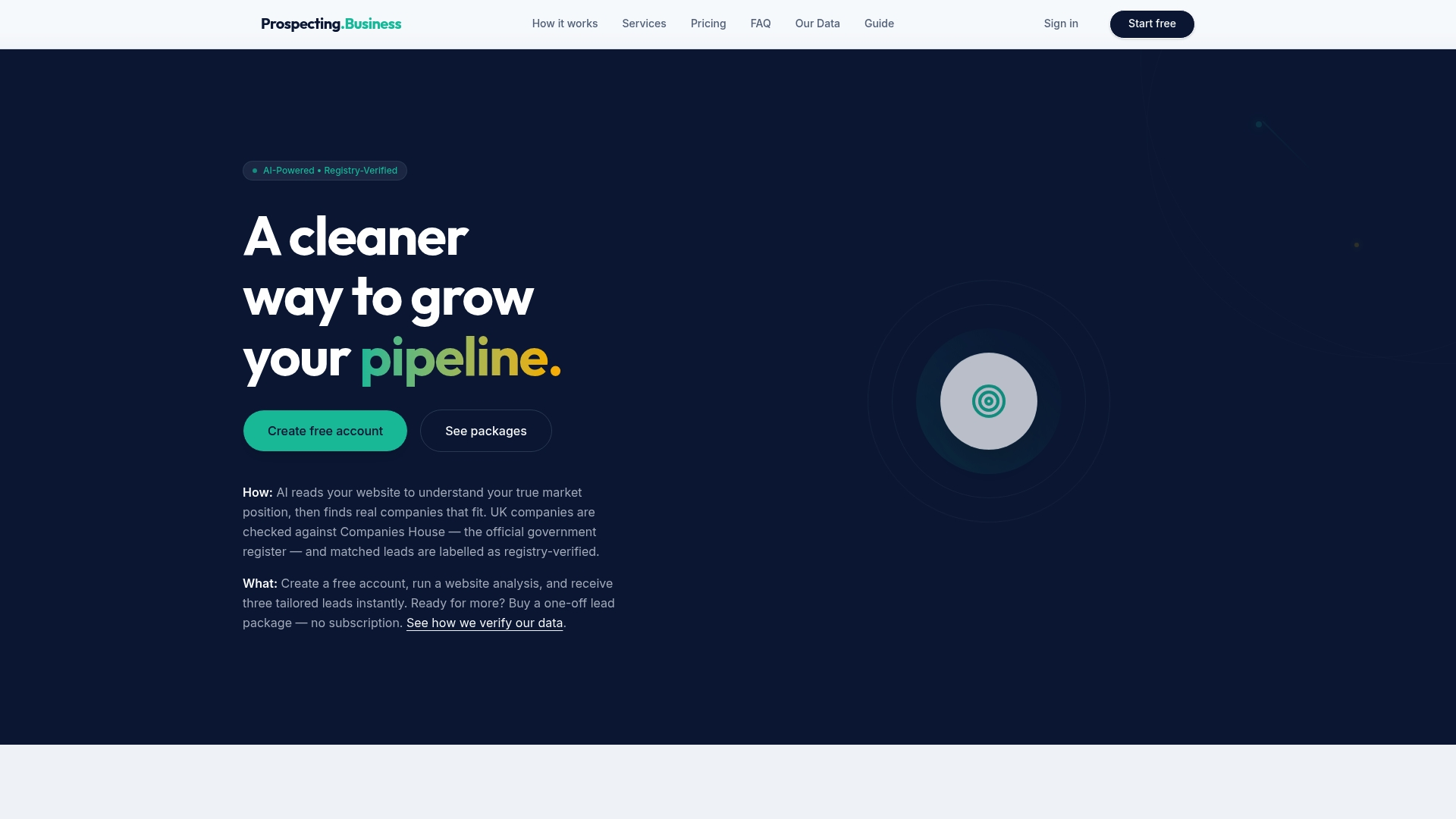
You receive contact names, emails, phone numbers, registered addresses, and outreach email drafts, without a subscription or a long-term contract. The pay-per-lead pricing model means you buy what you need, when you need it. Three tailored leads are available free to test the fit. For teams that want to understand how verification works before committing, the process is fully documented. Start with three free leads at Prospecting and see whether the quality matches your ICP.
Sources
- Predictive lead scoring for RevOps: how and when — Fairview
- How to build a lead scoring model that actually predicts conversions | Pecan AI
- Kumo
- Predictive lead scoring — Microsoft Dynamics 365 documentation