Warm leads vs cold leads: how to qualify and convert both

Warm leads vs cold leads: how to qualify and convert both
Cold leads have no prior relationship with you and need education before they will engage. Warm leads have already shown credible intent through a specific behaviour, and they need qualification and a timely follow-up. Hot leads are actively requesting a next step and need an immediate, high-touch response. As a rough benchmark, cold leads convert at around 1–3% while warm leads typically convert at 5–15%, so the routing decision you make at the top of the funnel has a direct effect on revenue.
The practical rule: cold = educate, warm = qualify, hot = act now.
Key takeaways
| Point | Details |
|---|---|
| Route by signal, not by gut | Use a scored threshold (e.g., 15+ points = MQL) to move contacts from cold nurture to sales contact automatically. |
| Respond to warm leads within 24 hours | First contact within 24 hours of the MQL threshold is the single most controllable conversion lever. |
| Run separate sequences | Cold and warm contacts need distinct cadences; mixing them dilutes personalisation and skews your metrics. |
| Measure cost per held meeting | Compare cold and warm cohorts on fully loaded cost per qualified opportunity, not raw lead counts. |
| Stay compliant | Complete a legitimate interest assessment before each cold campaign and honour opt-outs within 10 business days. |
Table of Contents
- What is a cold lead, and how should you approach one?
- What signals actually make a lead warm?
- What makes a lead hot, and what should you do immediately?
- Cold vs warm vs hot: how do they compare across the funnel?
- How to convert cold leads into warm leads, step by step
- How to qualify warm leads and move them from MQL to SQL
- When should you prioritise warm leads over cold ones?
- A one-page UK lead scoring card you can use today
- UK legal and privacy considerations for prospecting
- Sources
What is a cold lead, and how should you approach one?
A cold lead is a contact with no prior relationship with your business and no verified signal of intent. They have not visited your pricing page, downloaded your content, or replied to any outreach. You have their details because you bought a list, met them at a trade show, scraped a directory, or targeted them through outbound advertising.
Common sources and measurable signals that identify a cold lead:
- Sourced from a purchased or rented contact list
- Identified through LinkedIn Sales Navigator or a data provider without prior engagement
- Attended a trade show where your team collected badge scans
- Targeted via paid social or display advertising with no click-through or form fill
- No record of website visits, email opens, or content downloads in your CRM
- No inbound enquiry or reply to any previous outreach
The first two outreach steps matter more than most teams acknowledge. Before any message goes out, verify the contact against a reliable registry (for UK prospects, Companies House is the standard) and confirm you have a lawful basis for contact under PECR. Then lead with a specific, pain-led message tied to their sector or role, not a generic introduction. Keep volume controlled and run cold contacts in a separate sequence from warm ones, so signal-based routing can move them automatically when they engage.
What signals actually make a lead warm?
A warm lead has taken a credible, recent action that indicates genuine interest in your category or your specific offer. The key word is recent: engagement older than 90 days carries significantly less weight, and most practitioners treat a 30–90 day activity window as the relevant scoring period.
Signals that reliably indicate warmth include:
- Downloaded a piece of gated content (whitepaper, checklist, case study)
- Visited your pricing page at least once in the past 30 days
- Attended a webinar or live event you hosted
- Replied to a cold email, even with a question or objection
- Connected with your brand on LinkedIn and engaged with a post
- Returned to your website two or more times within a 30-day window
- Was referred by an existing customer or partner
When a contact fires one of these signals, the right response is fast and relevant. A warm outreach message should reference the specific action: “I noticed you downloaded our guide on X” outperforms a generic follow-up every time. Warm introductions and referrals in particular convert faster and at higher value than any cold channel, because trust transfers with the introduction.
Pro Tip: Set a CRM automation to tag any contact who visits your pricing page and alert the responsible sales rep within the same business day. Delay beyond 24 hours measurably reduces reply rates.

What makes a lead hot, and what should you do immediately?
A hot lead has moved beyond passive interest and is actively requesting a commercial next step. They have self-qualified by sharing budget, timeline, or a direct request for a proposal or demonstration.
Signals that classify a lead as hot:
- Submitted a demo request or “contact sales” form with a budget or timeline field completed
- Activated a free trial and logged in more than once within the first 48 hours
- Replied to outreach with an explicit question about pricing, contract terms, or implementation
- Requested a proposal or sent a brief
- Booked a meeting directly through a calendar link
The action checklist for a hot lead is short and time-sensitive:
- Respond within one business hour. Response time is the single biggest variable in hot-lead conversion.
- Confirm the meeting or next step in the same message. Do not leave the next action ambiguous.
- Prepare a tailored asset (case study, pricing summary, or ROI estimate) before the call.
- Assign ownership explicitly in your CRM. Hot leads must sit with a named sales rep, not a shared queue.
- Log the qualifying detail (budget, timeline, decision-maker status) immediately so it is available for the call.
Cold vs warm vs hot: how do they compare across the funnel?
| Dimension | Cold lead | Warm lead | Hot lead |
|---|---|---|---|
| Engagement level | No prior contact; no verified intent signal | Recent credible engagement (download, pricing visit, event, reply) within 30–90 days | Active commercial request (demo, pricing, proposal, trial activation) |
| Typical conversion rate | ~1–3% | ~5–15% | Varies; materially higher than warm |
| Best channels and approach | Targeted cold email, cold calling, paid social; pain-led, educational messaging | Personalised email referencing the signal, LinkedIn DM, phone follow-up | Direct call or video meeting; tailored proposal or demo |
| Typical timeline to close | Weeks to months; requires nurture sequence | Days to weeks depending on deal size | Hours to days; urgency is already present |
| MQL/SQL status | Pre-MQL; not yet qualified | MQL: meets engagement threshold; ready for qualification questions | SQL: budget, authority, need, and timeline confirmed |
| Recommended owner | Marketing automation or SDR outreach | SDR or AE with marketing support | Account Executive; escalate immediately |
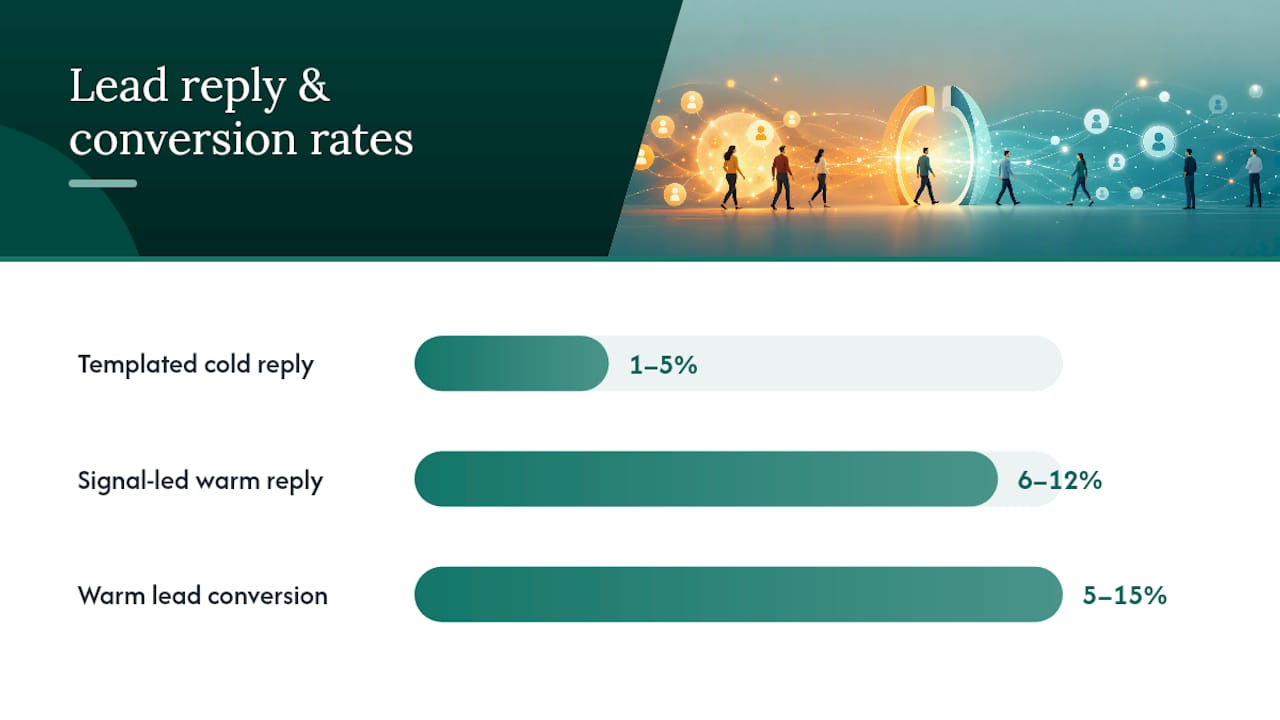
Signal-led warm outreach commonly produces first-send reply rates of around 6–12%, compared with a 1–5% benchmark for templated cold emails. That gap compounds across a full sequence, which is why routing accuracy at the point of first contact determines a significant share of pipeline quality.
How to convert cold leads into warm leads, step by step
Moving a contact from cold to warm is a process, not a single message. Here is a repeatable sequence:
-
Identify and segment. Pull your cold contacts and segment by industry, company size, and role. A message relevant to a 20-person professional services firm in Manchester will outperform a generic blast every time. Tight targeting is the foundation of everything that follows.
-
Attract with relevant content. Create or repurpose one piece of content that addresses a specific pain point for each segment. A short guide, a data-led post, or a practical checklist all work. The goal is to give the contact a reason to engage before you ask for anything.
-
Engage through the right channel. For most UK B2B contacts, a short, personalised cold email referencing their sector or a recent company development is the lowest-friction first touch. LinkedIn connection requests with a brief, relevant note work well for senior roles. Keep volume controlled and run cold contacts in a separate sequence from warm ones so that any engagement signal automatically triggers a move to the warm cadence.
-
Capture intent with a low-commitment offer. A gated asset (checklist, benchmark report, short webinar) gives cold contacts a reason to identify themselves. Landing pages with a single, clear call to action convert better than homepages. Dedicated landing pages, retargeting, and trial offers are among the most reliable tactics for generating warm signals from a cold audience.
-
Nurture with a sequenced follow-up. A three-to-five email sequence over two to three weeks, each message adding a distinct piece of value, is a practical starting point. Subject line idea for email one: “One thing [industry] teams get wrong about [pain point].” Body intent: deliver a single, useful insight with no ask. Email two references the first and offers the gated asset. Email three offers a brief call with a specific agenda.
Pro Tip: Segment cold lists by recency of data and by signal proximity (e.g., “attended competitor webinar” is warmer than “bought from a list provider”). Sending the same message to both groups wastes budget and damages deliverability.
A brief UK legal note: before emailing any cold contact, confirm you have a lawful basis under PECR. For B2B contacts at limited companies, legitimate interest is commonly used, but you must complete a legitimate interest assessment and honour opt-outs promptly.
How to qualify warm leads and move them from MQL to SQL
A warm lead becomes a marketing-qualified lead (MQL) when it meets a defined engagement threshold in your CRM, typically a score above a set point based on the signals in the scoring card below. It becomes a sales-qualified lead (SQL) when a sales rep has confirmed budget, authority, need, and timeline through direct conversation.
MQL qualification checklist:
- Has the contact engaged with at least two distinct assets or pages?
- Did the engagement occur within the past 30 days?
- Does the company fit your ideal customer profile (sector, size, geography)?
- Is the contact a decision-maker or influencer in the buying process?
Sample qualifying questions for the first sales conversation:
- “What prompted you to look at this now?” (surfaces timeline and urgency)
- “Who else is involved in this decision?” (confirms authority)
- “Do you have a budget allocated, or is this exploratory?” (surfaces budget)
- “What does success look like in the first 90 days?” (confirms need and fit)
The recommended cadence for warm leads is a first meaningful contact within 24 hours of the MQL threshold being reached, followed by a second touch at day three if there is no reply, and a third at day seven. After three unanswered touches, return the contact to a lower-frequency nurture sequence rather than abandoning them.
Live interactions such as calls and video meetings consistently outperform email alone for warm lead conversion, particularly for deals above a mid-market threshold. Assign warm leads to a named rep in your CRM at the point of MQL, not after the first reply.
A simple CRM routing rule: when lead score reaches the MQL threshold, automatically assign to the relevant sales rep, set a task for first contact within 24 hours, and pause all marketing automation sequences for that contact.
When should you prioritise warm leads over cold ones?
The conversion-rate gap is the clearest argument for prioritising warm leads. Cold outbound averages around 3.4% reply rate while warm programmes can reach 10–34% depending on signal strength and channel, according to SalesRobot’s benchmarks.
The ROI case for warm prioritisation is strong, but comparing cohorts fairly requires using fully loaded cost per held meeting or qualified opportunity, not raw lead counts. Cold lists are cheaper to acquire but more expensive to convert. Warm lists are smaller but yield a higher return per contact.
Cold outreach still makes sense in three situations: when you are entering a new market and have no existing warm contacts, when you need to build pipeline volume quickly at the top of the funnel, or when your ideal customer profile is narrow and you need to cover the full addressable market before enough inbound signals accumulate.
A one-page UK lead scoring card you can use today
Copy this into your CRM as a custom score field. Assign points when a signal fires, and route the contact based on their total.
Scoring signals:
- Visited pricing page (any visit in past 30 days): +15 points
- Downloaded gated content: +10 points
- Attended a webinar or live event: +10 points
- Referred by an existing customer or partner: +20 points
- Returned to the website two or more times in 30 days: +8 points
- Replied to any outreach (even a question or objection): +12 points
- Submitted a demo or contact form: +25 points
- Opened three or more emails in a single sequence: +5 points
- Company matches your ideal customer profile (sector, size, UK geography): +10 points
Routing thresholds:
- 0–14 points (Cold): Remain in automated nurture sequence. No sales contact yet. Review monthly.
- 15–39 points (Warm/MQL): Assign to SDR. First contact within 24 hours. Personalise outreach to the specific signal that triggered the threshold.
- 40+ points (Hot/SQL): Assign to Account Executive immediately. First contact within one business hour. Prepare a tailored asset before the call.
For UK-based prospecting, Prospecting verifies leads against the Companies House registry, which means the company-fit score can be pre-validated before a contact even enters your CRM. That removes one of the most common sources of wasted outreach: contacting companies that do not match your profile or are no longer active.
UK legal and privacy considerations for prospecting
UK B2B prospecting sits under the Privacy and Electronic Communications Regulations (PECR) and the UK GDPR. For most cold B2B email outreach to corporate email addresses, legitimate interest is the most commonly used lawful basis, provided you complete a legitimate interest assessment (LIA) and the processing is proportionate. Consent is required when contacting sole traders or partnerships at personal email addresses, or when sending marketing to individuals rather than corporate roles.
Pro Tip: Keep a simple LIA log in a shared document: record the purpose, the necessity test, and the balancing test for each outreach campaign. The ICO can request this documentation, and having it ready demonstrates accountability without requiring a legal team.
Practical compliance steps:
- Include a clear opt-out mechanism in every outreach message and honour it within 10 business days
- Do not re-contact anyone who has previously opted out, even if they appear on a new purchased list
- Retain records of consent or LIA completion for as long as you hold the contact’s data
- Review your privacy notice to confirm it covers outbound prospecting activity
For authoritative guidance, consult the ICO’s direct marketing guidance directly. The ICO’s PECR guidance is the primary reference for email and telephone marketing in the UK, and it is updated when enforcement positions change.
The case for starting with your warm signals this week
Most sales teams I speak with spend the majority of their outreach budget on cold contacts while their warm signals sit unworked in a CRM. A contact who visited your pricing page twice last week and downloaded a guide is not a cold lead. Treating them as one is a conversion problem disguised as a volume problem.
The practical starting point is a 20-minute warm-signal triage block each morning: filter your CRM for contacts who have fired a signal in the past 48 hours and prioritise those above everything else. Track warm and cold conversion rates separately from day one. Without separate metrics, you cannot see where your pipeline is actually coming from, and you will keep over-investing in the channel that feels busier rather than the one that converts.
Sources
The sources below underpin the benchmarks, outreach guidance, and compliance notes in this article.
- What Are Warm Leads? Definition, Examples, And Strategy In 2026
- Warm vs Cold Outreach: When to Use Each — Gangly Blog
- Cold Outbound vs. Warm Outbound: Conversion Rates | Via AI