AI lead generation for UK sales teams: pilot and tool checklist

AI lead generation for UK sales teams: pilot and tool checklist
AI lead generation uses machine learning and natural language processing to find, enrich and reach out to verified prospects at scale. For UK B2B teams, the recommended next step is a four-week pilot that validates lead quality against Companies House records before you commit to volume. Platforms like Prospecting cross-reference discovered companies against the Companies House registry, delivering verified contact data alongside outreach drafts so your team can focus on conversations rather than list-building. The legal baseline matters from day one: UK GDPR and PECR govern how you process and contact those prospects, so build compliance into the pilot, not as an afterthought.
Three outcomes you should expect from a well-run AI prospecting workflow:
- Find: AI discovers companies matching your ideal customer profile (ICP) from web signals, firmographic databases and public registries.
- Enrich and verify: Each match is enriched with contact names, roles, emails, phone numbers and registry data, then verified for accuracy.
- Outreach at scale: Personalised email sequences are generated and sequenced automatically, with human review before sending.
Two trade-offs to weigh before you start:
- Scale vs quality: Higher volume lists almost always contain more stale or inaccurate records. A smaller, verified set typically outperforms a large unverified one on conversion.
- Automation vs human touch: AI drafts outreach efficiently, but a human review step protects sender reputation and catches tone errors that models miss.
Pro Tip: During your pilot, request a sample of 20–30 leads and manually verify at least five against Companies House before sending a single email. That spot-check tells you more about vendor data quality than any sales deck.
Key takeaways
AI lead generation delivers the strongest results when discovery, verification and outreach are connected in a single workflow, grounded in a clearly defined ICP and validated against an authoritative registry like Companies House before any outreach begins.
| Point | Details |
|---|---|
| Define your ICP first | Specify sector, headcount, geography and decision-maker title before running any AI discovery workflow. |
| Verify before you send | Cross-reference every lead against Companies House and target a verification pass rate above 90% before launching outreach. |
| Run a four-week pilot | Track CPQL, reply rate and meetings booked from day one; use go/no-go gates to decide whether to scale. |
| Build compliance in from the start | Document your lawful basis, complete a DPIA note and maintain a suppression list before the first email is sent. |
| Prospecting as a starting point | Prospecting delivers Companies House-verified leads with outreach drafts and a free three-lead trial, with no subscription required to begin. |
Table of Contents
- What does AI lead generation actually do for your pipeline?
- How does AI lead generation work end-to-end?
- Seven practical AI workflows for B2B prospecting teams
- How do you choose the right AI lead gen tool for a UK team?
- Step-by-step pilot plan for a UK SMB
- What are the UK data and compliance requirements for AI lead generation?
- How do you measure success in AI lead generation?
- How do you protect deliverability and maximise response rates?
- What are the common pitfalls in AI lead generation and how do you avoid them?
- UK SMB use cases and example playbooks
- How does verified lead matching work with Prospecting?
- When is AI lead generation the right move for your team?
- Get started with a verified UK lead generation pilot
- Sources
What does AI lead generation actually do for your pipeline?
AI lead generation automates the core tasks of finding, qualifying and personalising outreach so sales teams can focus on high-value engagement rather than manual research. At its simplest, it replaces the spreadsheet-and-LinkedIn grind with a system that continuously discovers, scores and sequences prospects based on rules you define.
The capability set breaks into five areas:
- Discovery: AI scans firmographic databases, web sources and public registries to surface companies that match your ICP filters (sector, headcount, revenue band, geography).
- Enrichment: Each discovered company is augmented with contact-level data: decision-maker names, job titles, verified email addresses, direct-dial numbers and registered addresses.
- Predictive scoring: Machine learning models rank prospects by their likelihood to convert, drawing on behavioural signals, firmographic fit and historical CRM data.
- Personalised outreach: Natural language processing generates tailored email copy at scale, referencing company-specific details to lift reply rates above generic templates.
- Routing and reporting: Scored leads are assigned to reps based on territory, capacity or deal size, and pipeline dashboards track performance from first touch to closed deal.
The business benefits are concrete. Pipeline velocity increases because reps spend time on qualified prospects rather than cold research. Cost-per-lead falls when discovery and enrichment are automated. Targeting improves when scoring models are trained on your own conversion data rather than generic industry benchmarks. And personalised outreach at scale is simply not achievable manually for most SMB teams.
AI delivers the strongest results when three conditions are met: your CRM data is reasonably clean, you have a defined ICP with at least five firmographic filters, and you can commit someone to reviewing outputs weekly. Without those foundations, AI amplifies noise as readily as it amplifies signal. IBM notes that machine learning, NLP and predictive analytics are the technical building blocks behind these capabilities, and that human oversight remains critical for quality and legal risk management.
For early-stage UK businesses, the stakes are particularly high. Reliable customer acquisition is not a growth luxury; HubSpot’s analysis of startup failure rates consistently highlights poor customer acquisition as a leading cause of failure, which makes a verified, repeatable lead generation process one of the most valuable systems a young company can build.
How does AI lead generation work end-to-end?
The end-to-end flow runs from raw data ingestion through identity resolution, enrichment, scoring, sequence generation and delivery, with feedback loops feeding results back into the model. Each stage has a defined input, a processing step and a measurable output.
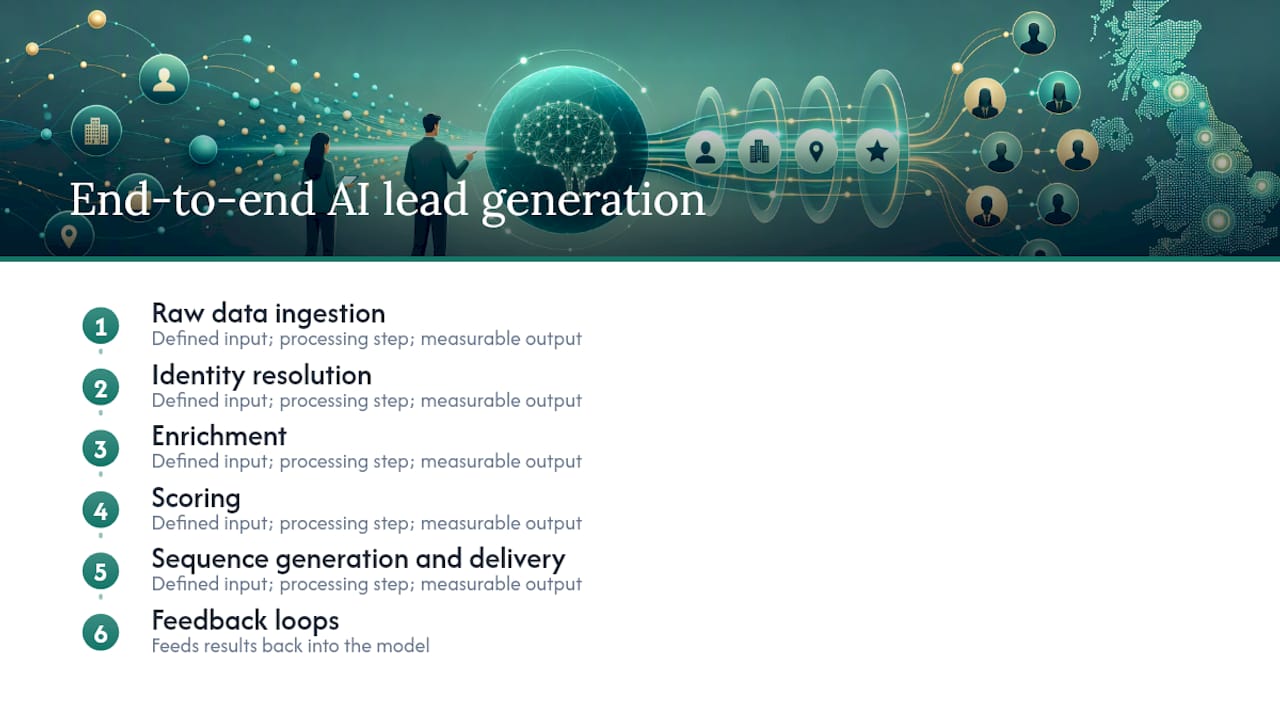
Data sources and identity resolution
The system pulls from multiple sources simultaneously: web crawls, firmographic databases, LinkedIn-derived signals, intent data providers and public registries such as Companies House. Identity resolution matches records across sources to build a single, deduplicated company profile. Without this step, the same company appears multiple times under different trading names or registered addresses, inflating list size and wasting outreach budget.
Enrichment, scoring and sequence generation
Once a company profile is resolved, enrichment layers in contact-level data. Predictive scoring then ranks each profile using a model trained on your historical conversion data or, at pilot stage, on industry-average benchmarks. Sequence generation uses NLP to draft personalised emails referencing the company’s sector, size and any detected intent signals.
| Capability | Primary data source | Expected output |
|---|---|---|
| Company discovery | Firmographic databases, web signals | Deduplicated company list matching ICP filters |
| Registry verification | Companies House | Company number, registered address, director names |
| Contact enrichment | Public web, professional directories | Decision-maker name, role, email, phone |
| Predictive scoring | CRM history, behavioural signals | Numeric score and priority tier |
| Sequence generation | NLP model, company profile | Personalised email drafts per prospect |
| Delivery and tracking | ESP (email service provider) | Open, click, reply and bounce data |
Automation workflow and human checkpoints
A typical automated workflow runs in this order:
- Define ICP filters and seed rules in the platform.
- AI discovers matching companies from connected data sources.
- Identity resolution deduplicates and merges records.
- Enrichment adds contact-level fields and registry verification.
- Scoring model ranks prospects and assigns priority tiers.
- Sequence generator drafts personalised emails for each tier.
- Human review checkpoint: a team member approves or edits drafts before sending.
- Approved sequences are delivered via your ESP with tracking enabled.
- Engagement data (opens, replies, bounces) feeds back into the scoring model.
- Weekly audit: spot-check a sample of delivered leads against Companies House records.
The human review at step seven is not optional. Generative models produce plausible-sounding copy that occasionally contains factual errors, wrong company names or tone mismatches. Catching those before delivery protects your sender reputation and keeps you on the right side of PECR’s requirements around unsolicited commercial communications.
Seven practical AI workflows for B2B prospecting teams
Each workflow below has defined inputs, outputs, a responsible role and a success metric. Pick the ones that match your current sales motion and run them in sequence rather than all at once.
1. ICP-seeded lead list expansion
Input: Your three to five best existing customers (sector, headcount, revenue, geography, tech stack). Process: Feed those firmographic attributes as seed rules. AI discovers lookalike companies, matches them against Companies House and enriches with contact data. Output: A verified list of 50–200 companies with decision-maker contacts.

2. Trigger-driven discovery and outreach
Gartner’s research on the B2B buying journey confirms that account-level buying signals are more actionable than static contact lists. Triggers such as a new funding round, a senior hire in a relevant function, or a technology stack change indicate a company is actively evaluating solutions.
Input: Trigger categories relevant to your offer (e.g., “new Head of Sales hired at a 50–200 person UK SaaS company”). Process: AI monitors sources for trigger events, surfaces matching accounts and generates a time-sensitive outreach draft referencing the trigger. Output: A short, timely email sequence sent within 48 hours of the trigger. Success metric: Reply rate on trigger-driven sequences vs baseline cold sequences.
3. Account-based micro-personalisation
Input: A shortlist of 20–50 target accounts. Process: Account research → persona mapping → AI draft → human personalise → sequence. Output: One bespoke email per account, referencing a specific company detail (recent news, product launch, hiring pattern). Success metric: Meeting booked rate per account contacted.
4. Inbound-conversion augmentation
Input: Website visitors or inbound enquiries. Process: AI chat qualifies the visitor (company size, intent, budget signal), scores the lead and hands off to a rep with the verified company profile and score attached. Output: Qualified meeting request with enriched company data pre-loaded in CRM. Success metric: Inbound-to-meeting conversion rate before and after AI qualification.
5. Cold-email sequence generation and A/B testing
Automate the structure and personalisation tokens; humanise the opening line and the specific ask. A three-step sequence works well: a short, personalised opener (step one), a value-evidence follow-up (step two) and a low-friction close (step three). A/B test one variable at a time: subject line, opening hook or call-to-action phrasing.
Success metric: Reply rate and positive-reply rate per variant.
6. Lead routing and SLA-driven assignment
Input: Scored leads from the discovery workflow. Process: Routing rules assign leads to reps based on score threshold, territory and rep capacity. Leads above a defined score go to senior reps; lower-scored leads enter a nurture sequence. Output: Every lead assigned within a defined SLA (e.g., four business hours for high-score leads). Success metric: Time-to-first-contact per lead tier.
7. Quality-control playbook
Run a weekly audit: pull a random sample of 10 leads from the previous week’s output, verify each against Companies House, check email validity and confirm the contact’s role is current. Log pass/fail rates in a simple spreadsheet.
Pro Tip: Set a calendar reminder for the same time each week to run this audit. Consistency matters more than the sample size. A weekly 10-lead check catches data drift far earlier than a monthly 50-lead review.
How do you choose the right AI lead gen tool for a UK team?
For UK SMBs, the features that move the needle most are verified UK data coverage, clean CRM integration and GDPR-compatible data handling. Everything else is secondary until those three are confirmed.
Selection checklist
- UK data coverage and Companies House verification: Does the platform verify company records against Companies House? Can it return company numbers, registered addresses and director data? Without this, you are working with unverified data in a jurisdiction where data accuracy is a legal obligation, not just a quality preference.
- CRM and ESP integration: Native connectors to your CRM (HubSpot, Salesforce, Pipedrive) and email service provider prevent manual data transfers that introduce errors and delay follow-up.
- Deliverability support: Does the platform provide domain warm-up guidance, bounce handling and suppression list management? Poor deliverability damages your sender domain permanently.
- Enrichment depth: Roles, direct emails, phone numbers and LinkedIn profiles. Shallow enrichment (company name and website only) is not sufficient for personalised outreach.
- Configurable scoring: Can you weight scoring criteria to match your ICP rather than accepting a generic model? Custom scoring materially improves prioritisation.
- Explainability and audit logs: Can you see why a lead was scored as it was? Audit logs are important for GDPR accountability obligations.
- Pricing model: Pay-per-lead suits pilots and variable-volume teams. Subscriptions suit teams with consistent monthly volume. Avoid platforms that lock you into annual contracts before you have validated quality.
- Data retention and privacy controls: Does the vendor publish a clear data retention schedule? Can you request deletion? Are they registered with the ICO?
Red flags to watch for
- Opaque data sourcing with no explanation of where contact data originates.
- No verification step or inability to demonstrate a Companies House match.
- Fixed email templates with no human override capability.
- Poor or non-existent CSV export options.
- Vendor lock-in clauses that prevent you from exporting your own lead data.
Pro Tip: Before signing anything, ask the vendor for a sample export of 10 leads in your target sector. Run each company number through the Companies House search at Find-and-update and check the contact email against a free email validation tool. That 20-minute test tells you more than any demo.
When comparing pricing models, pay-per-lead gives you cost certainty and zero commitment risk during a pilot. A DIY stack (combining separate discovery, enrichment and sequencing tools) offers flexibility but requires technical setup time and ongoing maintenance. Fully managed services remove operational burden but typically cost more per lead and offer less control over ICP configuration. For most UK SMBs running a first pilot, pay-per-lead with a verified, registry-checked provider is the lowest-risk starting point.
Step-by-step pilot plan for a UK SMB
The objective of a four-to-eight week pilot is straightforward: confirm that AI-sourced, registry-verified leads convert to qualified meetings at a cost-per-lead (CPL) that is commercially viable for your business. Everything in the pilot design serves that single measurement.
Week-by-week timeline
- Week 1: Setup. Define your ICP in writing (sector, headcount band, geography, decision-maker title). Map CRM fields to the lead data schema. Configure your sending domain with SPF, DKIM and DMARC. Begin domain warm-up if the domain is new or cold.
- Week 2: Seed and run. Input ICP rules into the platform. Request an initial batch of 50–100 verified leads. Spot-check 10 against Companies House before any outreach begins.
- Week 3: Outreach and measurement. Launch the first email sequence. Track opens, replies and bounces daily. Flag any hard bounces immediately and remove from the sequence.
- Week 4: Sample verification and iteration. Pull a second spot-check sample. Compare reply rates across ICP segments. Adjust scoring weights or ICP filters based on early data.
- Weeks 5–8 (optional extension): Run a second sequence variant (A/B test one element). Measure meeting-booked rate. Calculate CPL and compare against your baseline.
Experiment design
- Sample size: A minimum of 50 contacted prospects per variant gives you enough signal to distinguish noise from a genuine performance difference.
- Control group: Keep 20% of leads in a manual outreach control group to measure the AI-assisted uplift directly.
- A/B elements to test: Subject line (question vs statement), opening personalisation hook (company-specific vs role-specific), call-to-action (meeting request vs content offer).
Pilot checklist
- ICP defined in writing with at least five firmographic filters.
- CRM fields mapped and integration tested.
- Sending domain configured (SPF, DKIM, DMARC) and warm-up started.
- Data Protection Impact Assessment (DPIA) note completed for AI processing of personal data.
- Verification method confirmed (Companies House spot-check process documented).
- Reporting dashboard live with CPL, reply rate and meeting-booked rate tracked from day one.
Go/no-go decision gates
- Green: Verification pass rate above 90%, reply rate above 3%, CPL below your target threshold.
- Amber: Verification pass rate 75–90% or reply rate 1–3%. Investigate data source quality before scaling.
- Red: Verification pass rate below 75% or zero qualified meetings booked. Do not scale. Review ICP definition and vendor data quality.
Pro Tip: Complete your DPIA note before you send a single email. It does not need to be a lengthy document for a small pilot, but having a written record of your lawful basis, data sources and retention period protects you if a recipient raises a subject access request or complaint.
What are the UK data and compliance requirements for AI lead generation?
The legal baseline for UK outbound B2B prospecting is UK GDPR combined with the Privacy and Electronic Communications Regulations (PECR). The immediate steps to reduce regulatory risk are: identify your lawful basis before you collect or process any personal data, document it, and build a suppression list from day one.
Companies House as a verification and processing basis
Companies House data is publicly available and covers registered company names, company numbers, registered addresses and director information. Using it to verify that a company exists and is active is a legitimate processing activity. Director names and contact details derived from Companies House records are personal data under UK GDPR, so you still need a lawful basis to process and contact them. Prospecting verifies discovered matches against Companies House as part of its lead-verification pipeline, which improves accuracy and supports your own accountability obligations.
Legitimate interest vs consent
For cold B2B email outreach to corporate addresses (e.g., firstname@companyname.co.uk), legitimate interest is the most commonly used lawful basis under UK GDPR, provided you complete a Legitimate Interest Assessment (LIA) and the processing passes the three-part test: purpose, necessity and balance. PECR adds a separate layer: unsolicited direct marketing by electronic means to individual subscribers requires consent, but business-to-business communications to corporate addresses are generally covered by the soft opt-in or legitimate interest route, subject to the right to opt out being clearly provided.
Practical PECR checkpoints:
- Every outreach email must include a clear, easy opt-out mechanism.
- Honour opt-out requests promptly (within a few days at most).
- Do not contact individuals who have previously opted out or are on a suppression list.
- If you are contacting sole traders or partnerships, treat them as individuals under PECR, not as corporate entities.
Practical privacy steps
- DPIA: For AI processing of personal data at scale, a Data Protection Impact Assessment is required under UK GDPR Article 35 when the processing is likely to result in a high risk to individuals. A short, structured note covering data sources, processing purposes, risks and mitigations is sufficient for a small pilot.
- Record of processing activities (ROPA): Document the lead generation workflow as a processing activity, including data sources, retention periods and the lawful basis.
- Retention schedule: Define how long you will hold lead data. A 12-month rolling retention period with annual review is a common and defensible approach.
- Right to object: Any prospect can object to processing for direct marketing. Your CRM must be able to flag and suppress that contact immediately.
- Cookie and tracking transparency: If you are using tracking pixels in outreach emails, your privacy notice should disclose this.
Pro Tip: When evaluating vendors, ask for their data provenance statement in writing: where does the contact data originate, how recently was it verified, what is their deletion process when you terminate the contract, and are they registered with the ICO? A vendor who cannot answer those four questions clearly is a compliance liability, not just a data quality risk.
How do you measure success in AI lead generation?
The north-star KPI is cost-per-qualified-lead (CPQL): the total spend on the AI lead generation workflow divided by the number of leads that convert to a qualified sales meeting. Track it weekly during a pilot and monthly at scale.
| KPI | Formula | Reporting cadence |
|---|---|---|
| Cost-per-qualified-lead (CPQL) | Total workflow spend ÷ qualified meetings booked | Weekly (pilot), monthly (scale) |
| Lead volume | Total verified leads delivered per period | Weekly |
| Email open rate | Unique opens ÷ delivered emails × 100 | Per sequence |
| Email reply rate | Replies ÷ delivered emails × 100 | Per sequence |
| Verification pass rate | Leads passing Companies House check ÷ total leads × 100 | Weekly |
| Pipeline velocity | Average days from first contact to qualified meeting | Monthly |
| Conversion rate | Qualified meetings ÷ total leads contacted × 100 | Monthly |
Baseline benchmarking and uplift measurement
Before you launch the AI workflow, record your current CPL, reply rate and meeting-booked rate from manual prospecting. That baseline is your control. At the end of the pilot, compare the AI-assisted figures against it. Attribution is straightforward when you keep AI-sourced leads in a separate CRM pipeline stage: every deal that enters that stage and progresses to a qualified meeting is attributable to the workflow.
For stakeholder reporting, the most persuasive metric is pipeline value generated per pound spent on the AI workflow. Calculate it by multiplying the number of qualified meetings by your average deal value and your historical meeting-to-close rate. That figure translates AI prospecting spend into a projected revenue contribution that finance teams understand immediately.
Dashboarding essentials
Connect your ESP, CRM and verification log to a single reporting view. Google Looker Studio or a simple HubSpot dashboard works well for most SMBs. The four charts that matter most are: leads delivered over time, verification pass rate trend, reply rate by sequence variant and CPQL trend. If CPQL is rising week-on-week, investigate data quality before increasing spend.
How do you protect deliverability and maximise response rates?
Domain warm-up, list hygiene and engagement-focused content are the three factors that most reliably protect sender reputation and lift reply rates. Get those right before you worry about subject line optimisation.
Technical deliverability checklist
- SPF record: Publish a Sender Policy Framework record for your sending domain to authorise your ESP.
- DKIM: Enable DomainKeys Identified Mail signing on all outbound emails.
- DMARC: Set a DMARC policy (start with
p=noneto monitor, then move top=quarantineonce you have confirmed legitimate traffic patterns). - Domain warm-up: If your sending domain is new or has been dormant, send no more than 20–30 emails per day in the first two weeks, increasing gradually over four to six weeks.
- Subdomain strategy: Use a subdomain (e.g., outreach.yourcompany.co.uk) for cold prospecting to protect your primary domain’s reputation.
- ESP throttling: Configure your ESP to send at a controlled rate rather than blasting a full list in one go.
- Suppression list: Maintain a live suppression list of hard bounces, opt-outs and known invalid addresses. Sync it with your CRM daily.
Content and sequence best practices
- Opening line: Reference something specific to the recipient’s company. A single, accurate personalisation detail (a recent hire, a product launch, a sector-specific challenge) outperforms a generic opener every time.
- Single ask: Each email should request one thing only. A meeting, a reply, a content download. Multiple asks reduce response rates.
- Cadence spacing: Space follow-ups at least three to four business days apart. Back-to-back emails in 24 hours damage both response rates and sender reputation.
- Re-engagement rule: After three unanswered emails, pause the sequence for 30 days before attempting a re-engagement message with a different angle.
- Plain text formatting: HTML-heavy emails with multiple images trigger spam filters more readily than plain-text or lightly formatted messages.
Three-step cold-email sequence outline
Email 1 (Day 1): Personalised opener referencing a specific company detail. One sentence on what you do and for whom. Single ask: a 15-minute call.
Email 2 (Day 5): Brief follow-up. Reference a relevant outcome or example (without naming a client). Restate the ask in a different form (e.g., “Would a short email exchange work better?”).
Email 3 (Day 10): Low-friction close. Acknowledge they may not be the right person or the timing may be off. Offer to reconnect in a future quarter. Keep it under five sentences.
Pro Tip: Never personalise with data that feels intrusive. Referencing a company’s recent funding round is relevant and professional. Referencing an individual’s personal LinkedIn activity or location data crosses into territory that triggers privacy concerns and damages trust before the conversation starts.
What are the common pitfalls in AI lead generation and how do you avoid them?
Most AI prospecting failures trace back to a small number of predictable problems. Knowing them in advance lets you build mitigations into the workflow from the start rather than diagnosing them after budget has been spent.
- Stale or incorrect data: Contact data decays quickly. A person changes role, a company dissolves or moves address. Mitigation: Verify against Companies House at the point of delivery, not just at list-build. Re-verify any lead older than 90 days before outreach.
- Model hallucinations: Generative models occasionally produce confident-sounding but factually wrong personalisation details (wrong product names, incorrect company descriptions). Mitigation: Human review of all AI-drafted emails before sending. Flag any email that references a specific company fact for manual verification.
- Over-personalisation and privacy concerns: Using data points that feel surveillance-like (individual browsing behaviour, inferred personal characteristics) can cause recipients to complain or report spam. Mitigation: Restrict personalisation to firmographic and publicly available company-level data. Avoid referencing individual-level behavioural data in outreach.
- Deliverability damage: Sending to unverified lists at high volume destroys sender reputation within weeks. Mitigation: Enforce the verification pass-rate gate (above 90%) before any sequence launches. Monitor bounce rates daily and pause immediately if hard bounces exceed 2% of sends.
- Scoring bias and data drift: A scoring model trained on historical data reflects past conversion patterns, which may not hold as your ICP or market shifts. Mitigation: Review scoring model performance quarterly. Compare predicted scores against actual conversion rates. Recalibrate weights when the correlation weakens.
- Vendor data provenance opacity: Some providers cannot explain where their contact data originates or when it was last verified. Mitigation: Require a written data provenance statement before contract signature. If the vendor cannot provide one, treat that as a disqualifying red flag.
Pro Tip: Build a simple data quality log: a shared spreadsheet tracking verification pass rate, bounce rate and reply rate by week. A single glance at the trend line tells you whether data quality is holding or degrading. Review it every Monday morning before approving the week’s outreach.
UK SMB use cases and example playbooks
Three scenarios cover the most common sales motions for UK SMBs using AI prospecting tools. Each has a defined objective, a workflow summary and a measurable outcome.
1. SaaS company targeting UK mid-market businesses
Objective: Book 10 qualified discovery calls per month with Operations or Finance Directors at UK companies with 50–250 employees in professional services.
Workflow: Feed ICP filters (sector: professional services, headcount: 50–250, title: Operations Director or Finance Director, geography: England and Wales) into the platform. AI discovers matching companies, verifies each against Companies House and enriches with direct contact data. A three-step email sequence references the company’s sector and a common operational challenge. Leads scoring above the threshold are routed to a senior SDR for personalised follow-up.
Verification step: Companies House number confirmed, registered address current, director data cross-checked.
KPI: Meetings booked per 100 leads contacted.
2. Consultancy targeting finance sector leads
Objective: Generate a pipeline of 20 qualified prospects per quarter among UK financial services firms with 10–50 employees seeking regulatory compliance support.
Workflow: ICP seed built from three existing clients. AI discovers lookalike firms, applies sector filter (SIC codes for financial services), verifies against Companies House and identifies the Compliance Officer or Managing Director as the primary contact. Trigger monitoring flags firms that have recently registered or changed directors, indicating potential compliance review activity.
Verification step: SIC code confirmed, company status active, director name verified.
KPI: Qualified meetings per quarter and CPL against a manually prospected baseline.
3. Hardware vendor targeting UK independent retailers
Objective: Identify 50 independent UK retailers in a specific product category for a new distribution partnership outreach.
Workflow: ICP defined by retail SIC codes, headcount under 20, geography: specific UK regions. AI discovers matching companies, verifies trading status against Companies House and enriches with owner or buyer contact details. Outreach focuses on the partnership value proposition rather than a direct sale.
Verification step: Company status active, trading address confirmed, contact role verified as owner or buyer.
KPI: Partnership enquiry rate and response rate vs sector average.
A short note on regulated sectors: financial services, healthcare and legal firms face additional obligations around marketing communications. If your target sector is regulated, add an explicit compliance review step before any outreach sequence launches, and consider seeking legal advice on the specific rules governing marketing to that sector.
How does verified lead matching work with Prospecting?
Prospecting’s methodology runs in five stages: client website analysis, ICP mapping, company discovery, Companies House verification and contact enrichment with outreach draft generation.

Stage 1: Website analysis. Prospecting analyses your website to determine your market positioning and the type of company most likely to be a good fit. This removes the need for you to manually define every ICP attribute from scratch.
Stage 2: ICP mapping. The platform maps the inferred positioning to a set of firmographic filters: sector, company size, geography and decision-maker profile.
Stage 3: Company discovery. AI discovers UK companies matching those filters from connected data sources.
Stage 4: Companies House verification. Each discovered company is cross-referenced against Companies House to confirm the company is registered, active and correctly identified. This step returns the company number, registered address and director data where available.
Stage 5: Contact enrichment and outreach draft. Verified companies are enriched with decision-maker contact details (name, role, email, phone). An outreach email draft is generated for each lead, ready for human review before sending.
Example lead output schema
| Field | Description |
|---|---|
| Company name | Registered trading name |
| Company number | Companies House registration number |
| Registered address | Address as filed at Companies House |
| Director name | Named director from Companies House record |
| Contact name | Decision-maker identified for outreach |
| Contact role | Job title of the identified contact |
| Email address | Verified contact email |
| Phone number | Direct dial or company number where available |
| Verification flag | Pass/fail status from Companies House check |
| Outreach draft | AI-generated personalised email draft |
Buyer questions to ask any vendor during a pilot
- Where does your contact data originate, and how recently was it verified?
- Can you demonstrate a live Companies House match for a sample lead?
- What is your deletion process when a contract ends?
- Are you registered with the ICO, and can you share your data provenance statement?
- What is your average verification pass rate across UK leads in my target sector?
The rapid growth of the lead-generation technology sector, noted in coverage of funding activity among prospecting startups, reflects genuine market demand. That growth also means more vendors making claims that are difficult to verify without a structured pilot. Asking these questions before you commit separates providers with genuine verification infrastructure from those relying on unverified bulk data.
When is AI lead generation the right move for your team?
The honest answer is that AI prospecting amplifies what is already working. If your ICP is vague, your CRM is a mess and no one owns the outreach process, adding AI to that situation produces more noise at higher speed.
A short readiness check:
- Data maturity: Do you have at least 10 closed-won deals you can describe with five or more firmographic attributes? If yes, you have enough signal to seed an AI discovery model.
- CRM hygiene: Are your existing contacts tagged by company, role and deal stage? If not, fix that first. AI-sourced leads fed into a disorganised CRM disappear.
- Defined ICP: Can you describe your ideal customer in one sentence, including sector, size, geography and decision-maker title? If you need a paragraph, the ICP is not defined enough.
- Capacity to handle volume: Do you have someone who can review AI outputs, run the weekly audit and manage replies? AI generates volume; humans convert it.
If you cannot tick all four, the right move is a managed service rather than a self-serve stack. A managed provider handles the operational complexity while you focus on closing. Once your ICP is sharp and your CRM is clean, migrating to a self-serve or hybrid model becomes straightforward.
For UK SMBs that meet the readiness criteria, Prospecting offers a low-friction entry point: verified leads, Companies House checks and outreach drafts, with no subscription required to start.
Get started with a verified UK lead generation pilot
Three verified leads, no subscription required. That is the entry point Prospecting offers UK sales teams who want to test AI-powered B2B prospecting without committing to a monthly contract. Every lead is cross-referenced against Companies House, enriched with contact details and delivered with an outreach draft ready for human review.
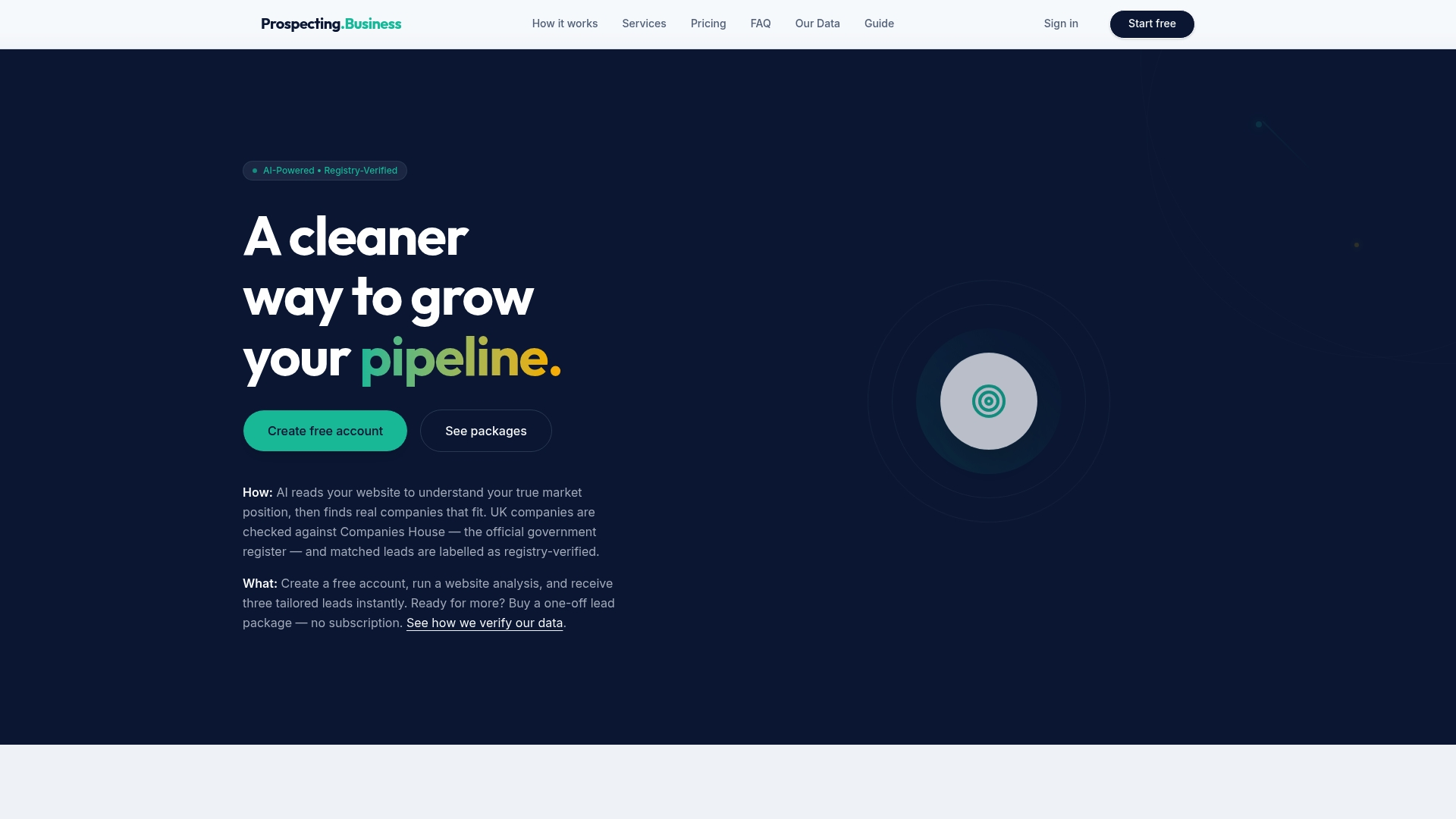
The pilot setup takes less than a day. You provide your website URL; Prospecting analyses your positioning, maps your ICP and delivers your first three verified leads. From there, you can purchase additional leads on a pay-per-lead basis or move to a subscription plan that suits your volume. Each lead includes the company number, registered address, director data, contact name, email, phone and a personalised outreach draft. CSV export is included, so your CRM receives clean, structured data from the first delivery.
Data handling is transparent: Prospecting publishes its verification methodology and privacy approach, and you can review both before you commit. To see exactly how verification works, visit the how we verify page. To start your free three-lead trial, go to prospecting.business.
Sources
The sources below underpin the claims in this article and are the most useful references for UK teams building or evaluating an AI lead generation workflow.